Oneiros Vision | OV Risk TerminalInstitutional Rigor.
Zero Compromise.
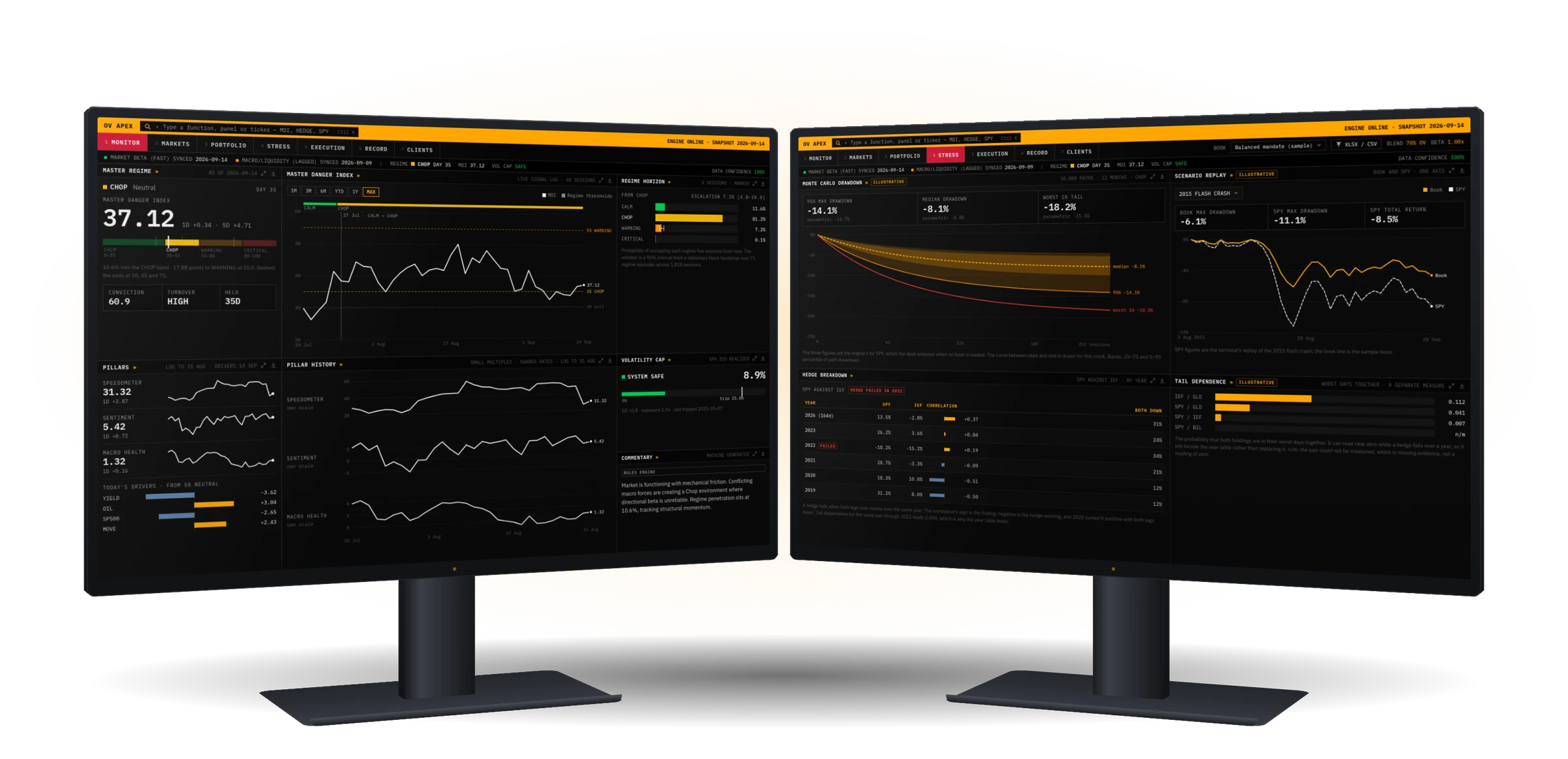
A risk terminal for portfolio managers. It reads today’s market regime from US liquidity, credit, volatility and sentiment data, and measures each client’s book against it, in the client’s currency and against the client’s mandate. It measures. Every decision stays yours.
Built for portfolio managers, wealth managers, family offices and RIAs. Books held as positions in francs, euros, sterling or dollars; crisis replay and stress; mandate limits, 10% depreciation notices and a dated, tamper-evident record of what was monitored.
An American signal. Measured on your index, in your currency.
Every input to the Master Danger Index is a United States series, and nothing here pretends otherwise. The fair question from a desk outside the US is whether an American signal says anything about their market — so it was measured, against four criteria fixed in writing before the first run, and the index that failed is published alongside the three that passed.
Switzerland
The regime has ranked forward drawdown on the SMI since 2010.
- 71.4% of the SMI’s worst 1% of sessions fell inside a defensive regime, on 31.8% of sessions, across 22 independent stress episodes.
- In francs the same track drew down 30.11%, against 13.61% in dollars. Only 7.60 points of that was the strategy; the rest was the exchange rate. You are shown your own currency, not ours.
- The 2015 SNB floor removal and the March 2023 Credit Suisse weekend are both in the crisis replay.
European Union
The regime has ranked forward drawdown on the EURO STOXX 50 since 2010.
- 73.8% of the index’s worst 1% of sessions held on 31.7% of sessions, across 28 independent stress episodes — the most of any index measured.
- Evidence for the 10% depreciation notice under MiFID II Article 62, and for liquidity stress testing under ESMA34-39-897.
- MSCI World did not pass and is published as a failure: 17 independent episodes against the 20 required. Not demonstrated is not the same as does not work, and it is not being re-run for a better number.
United Kingdom
The regime identifies UK stress at least as well as it identifies American stress.
- 81.4% of the FTSE 100’s worst 1% of sessions fell inside a defensive regime — the highest tail capture in the study, higher than the S&P 500 control’s 76.2%.
- Its drawdown gradient is the shallowest measured, 1.42x against the control’s 1.99x. The value to a British book is in avoiding the worst sessions, not in cutting typical drawdown. Both halves are published.
- Sterling reporting, UK stamp duty stated on the trade ticket as a transaction cost, and the 2016 referendum and September 2022 gilt and LDI crisis in the crisis replay.
Whose obligation is whose. Oneiros Vision measures. It places no orders, holds no client money or assets, exercises no discretion and makes no recommendation. MiFID II, COBS, ESMA, SYSC and DORA bind your firm, not us. The platform produces evidence you may cite; it certifies nothing, and it is not registered, authorised or approved by any regulator.
For desks that answer to a mandate.
Wealth Managers & Family Offices
Books held as positions - shares, values and cash - in francs, euros, sterling or dollars. Each mandate's limits checked before and after the orders, its 10% depreciation threshold watched with the notice deadline, and private holdings carried through a public proxy you choose.
Portfolio Managers
How the book as held behaved in each regime since 2010, in the days that mattered and under stated shocks. Your own target turned into the orders a desk receives: whole shares, days at 20% of volume, European transaction taxes, cash before and after.
RIAs & Independent Advisers
Every client's stated tolerance beside the measured bound, a client summary in plain language, and an e-mail when the regime changes or a limit is breached. The terminal measures and discloses; the advice stays yours.
Small Practices
One subscription, three named advisers, one set of books. A book saved by anyone in the practice is on every adviser's desk with who saved it, and CLIENTS reads across the whole practice.
Compliance & Oversight
A dated, hash-chained record of what was measured on each mandate and who acknowledged it, the book's VaR backtested against its own history, and every limit breach kept as a dated episode.
A regime reading you can audit.
A Reading, Not a Forecast
The Master Danger Index scores market stress from 0 to 100 and files it into four regimes: CALM, CHOP, WARNING and CRITICAL. It reads today. It does not predict tomorrow, and it is not advice.
Built From Measured Inputs
Speedometer (cross-asset volatility), Sentiment (fear and positioning) and Macro Health (liquidity, credit and the yield curve), all from published US series. Rules-based and reproducible, with each input's contribution shown on the screen.
Stable by Design
A volatility circuit breaker, a five-session consensus filter, hysteresis and a conviction score keep regime changes to about ten a year in the backtest (10.2), so a desk is not asked to react to noise.
A Record That Cannot Be Rewritten
Every regime call since 20 July 2026 is in an append-only, hash-chained log. A call is never revised and a missed session is never back-filled; an edit to any entry would break every digest after it.
Honest About Its Evidence
In the backtest the regime's value is mainly drawdown: against a matched static mix it cut maximum drawdown by 7 to 12 points in every allocation tested, and added 0.8 to 1.5 points a year. Outside the US it turns defensive during falls rather than ahead of them, and the studies publish what failed.
Institutional Portfolio Analytics
Risk measured on the client's own book: Expected Shortfall per holding, a hierarchical risk parity reference on a denoised covariance, how its hedges behaved in the years that mattered, liquidity stress and currency exposure.
Measured on the client’s own book.
Beyond the regime, the terminal measures each client book for the conversations a portfolio manager actually has: with the client, with the investment committee and with compliance.
Regime Horizon
Five-Session Base Rates
How often the regime has moved from today's state within five sessions, counted from its history since 2010 rather than modelled, with a 95% interval and the number of independent episodes behind it - because a rate drawn from a few dozen episodes is a range, not a point.
Monte Carlo Simulation
Probabilistic Loss Fan Chart
Paths are resampled from the portfolio's own return history rather than drawn from a normal distribution, so volatility clustering survives into the tail. The downside reads as a frequency, never a cap: 19 of 20 simulated years stay inside the figure, so roughly one in twenty is worse.
Crisis Replay & Shocks
The Days That Mattered
The book as held today, through every crisis window since 2010 - the ones that went against the regime included - with its market down 10, 20 or 30% and each foreign currency 10% against its base, and through its market's ten worst weeks with the capture ratios beside them.
Risk Contribution
Expected Shortfall Per Holding
Value at Risk says how bad a bad day is. Expected Shortfall says how bad the days beyond it are - the measure Basel put in VaR's place. Each holding carries its share of the tail loss beside its share of the volatility: a position can be a fifth of the variance and half the loss.
Hedge Breakdown
When Diversification Stopped Working
A correlation describes an average day. This measures whether a hedge held in the years that mattered: both legs down, the sign of the relationship inverting, and the share of sessions they fell together - measured on the client's own book rather than asserted from a chart.
Try It As a Book
A Target Before Trading It
Put your own target on the desk as a sandbox: the portfolio and stress screens measure it before anything is traded, and nothing is saved until you choose. The orders always start from the book as held.
Mandate Check
PASS or BREACH, Before and After
Your mandate's limits - equity, single position, cash, foreign currency, credit, issuer, US domicile, liquidity - checked on the book today and after the orders, with tolerance for rounding so a figure at its limit never reads as a breach.
Holdings vs Risk Parity
A Yardstick, Not a Target
Hierarchical risk parity on a denoised, robust covariance shows how far the book sits from a risk-balanced reference. It is a yardstick for the conversation, not a recommendation: the terminal sets no target.
Signal Attribution
Why The Index Reads What It Reads
The bridge from 50 to today's reading, pillar by pillar, with the drivers that moved it - so a reading can be explained to an investment committee rather than taken on trust.
Engineered for Resilience
What the service does to protect a firm’s data, written as plainly as the analytics are: every line here can be shown to your reviewer.
Accounts and Firms Kept Apart
Every book belongs to one account, or to one firm whose advisers share it, and no route reads another account's books. A client's file is read in the browser and only its holdings are sent; the uploader asks that files not be named after clients.
MDI Regime Processing
Cross-asset volatility, fear and positioning, and liquidity and credit, combined by fixed rules into one 0-100 score. Reproducible from its inputs, with every session's reading logged once and never revised.
Security, Stated Plainly
Two-factor sign-in on every account. Passwords hashed with bcrypt and checked against known breaches; session cookies HttpOnly and Secure; HSTS and TLS 1.2 or 1.3 on every host. The database accepts no connection from the internet, an encrypted off-site backup is made every night, and account and administrator actions are written to an audit log. A written security overview and our data processing terms are available on request.
The API
The API plan reads the terminal's measurements from your own systems: the regime reading and its history, and a portfolio's behaviour in each regime, its risk and its stress figures. Keys per account, restricted to your IP addresses if you choose, every call logged. It returns measurements, never an allocation or a trade instruction.
Measure your book against
today’s regime.
For portfolio managers and wealth professionals. Load the sample book or one of your own, and see every screen on it.
Start your 14-day free trial today.